


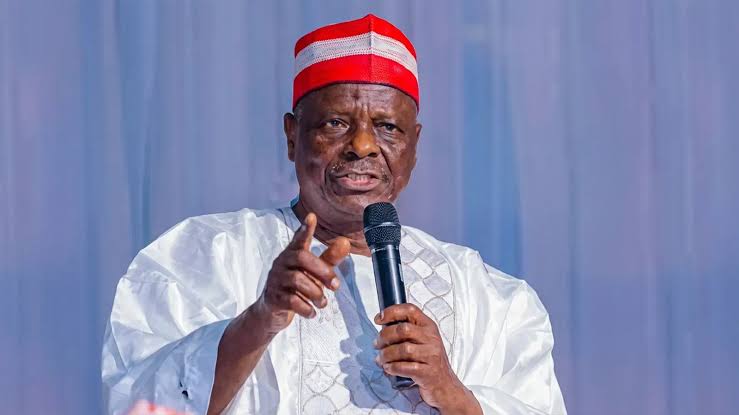
Kwankwaso warning to Tinubu ahead of 2027 says 30 APC governors cannot guarantee victory, citing Goodluck Jonathan’s defeat as a sitting president
Former Kano State governor and Nigeria Democratic Congress presidential running mate Rabiu Musa Kwankwaso has issued a sharp warning to President Bola Ahmed Tinubu ahead of the 2027 election, arguing that the backing of more than 30 All Progressives Congress governors cannot guarantee victory.
Also read:Jigawa Parties Sign Peace Accord Ahead of 2027 Elections
Kwankwaso made the remarks in Port Harcourt, Rivers State, on Thursday, September 3, 2026, during a town hall meeting where he questioned the electoral strength of the APC and criticised the performance of governors elected on the party’s platform.
The former Kano governor said the assumption that a large number of governors automatically translates into electoral victory could prove misleading.
Kwankwaso pointed to the 2015 presidential election, when then-President Goodluck Jonathan lost his bid for a second term to Muhammadu Buhari, despite contesting as an incumbent.

“Jonathan was the sitting president, and he lost the election,” Kwankwaso said.
He argued that the precedent should serve as a warning to political actors who believe that control of numerous state governments makes defeat impossible.
“Those who think that because they have more than 30 governors, they cannot lose are making a very big mistake,” he added.
Kwankwaso’s comments come as Nigeria’s political parties and emerging alliances intensify preparations for the 2027 presidential contest.
The NDC has positioned itself as an alternative political platform, with Peter Obi as its presidential candidate and Kwankwaso serving as his running mate. The pairing brings together two prominent opposition figures with established political bases in different parts of the country.
At the Port Harcourt meeting, Kwankwaso also questioned the performance of APC governors, saying their records in office could undermine their ability to campaign effectively for Tinubu.
“The trend is that those governors and their parties have performed woefully,” he said.
Kwankwaso claimed that some governors would struggle to campaign on the basis of their records, alleging that “from top to bottom, they did absolutely nothing”.
The remarks represent a direct challenge to the importance often attached to incumbency and political structures in Nigerian elections.
Governors can play a significant role in presidential campaigns through party organisation, mobilisation and local political networks. Their influence can be particularly important because state-level structures often determine how effectively parties reach voters across local government areas.
However, Nigeria’s recent electoral history also shows that incumbency and political control at state level do not automatically guarantee a presidential victory.
Jonathan’s defeat in 2015 remains one of the clearest examples. Buhari defeated the incumbent across a number of key states and became the first opposition candidate to unseat a sitting Nigerian president through the ballot box.
The result demonstrated that voter sentiment, regional political dynamics, party organisation, economic conditions and the popularity of individual candidates can combine in ways that overcome the advantages of incumbency.
Tinubu enters the 2027 contest with the benefit of controlling the federal government and a substantial APC political structure. The party’s governors are therefore expected to play an important role in his re-election campaign.
The president’s supporters, however, are likely to point to the administration’s economic reforms, infrastructure projects and other policy measures as part of the case for a second term.
Opposition parties are expected to focus heavily on the cost of living, unemployment, insecurity and the wider impact of economic reforms as they seek to challenge the ruling party.
Kwankwaso’s intervention adds to an increasingly competitive political conversation ahead of the election, particularly as opposition figures seek to convince voters that APC’s organisational strength should not be mistaken for guaranteed popular support.
The former Kano governor’s comments also follow Peter Obi’s call for Nigerians’ votes to count in 2027, with the NDC leadership increasingly emphasising electoral integrity and the need for political leaders to answer directly to voters.
For Tinubu and the APC, the remarks underline the challenge of converting political control into popular support.
For the opposition, the task will be to translate criticism of the ruling party into a credible national campaign capable of attracting voters across Nigeria’s diverse political landscape.
With the 2027 election still ahead, neither the number of governors controlled by a party nor the strength of its political machinery can determine the final outcome on its own.
Also read:Jigawa Parties Sign Peace Accord Ahead of 2027 Elections
Ultimately, voters will decide whether Tinubu secures another term or whether the opposition can repeat the kind of incumbent defeat that Kwankwaso invoked in Port Harcourt.


